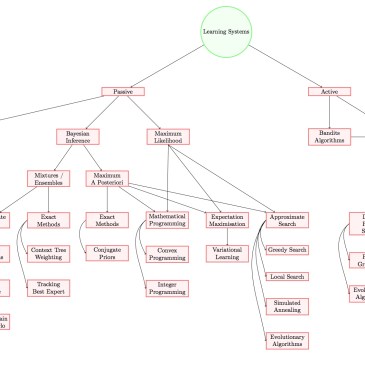
A Map of Machine Learning Principles and Algorithms

Here is my attempt to map out the major classes of algorithms in Machine Learning, organised around the associated induction principles and learning theory. The usual caveats apply around this being biased towards my own experience. At the highest level, we can distinguish between the Passive and Active learning settings. In the passive case, the … More A Map of Machine Learning Principles and Algorithms

A Direct Approximation of AIXI using Logical State Abstractions

Artificial Intelligence as a well-defined mathematical problem was solved a number of years ago through the formulation of the AIXI agent by Prof Marcus Hutter — see https://theconversation.com/to-create-a-super-intelligent-machine-start-with-an-equation-20756 for a quick introduction — but a key fundamental issue with the AIXI theory has always been the incomputability of the general solution. In a continuation of … More A Direct Approximation of AIXI using Logical State Abstractions

Bayesian Filtering on Structured Environments

A few colleagues and I have just completed a new research paper titled Factored Conditional Filtering: Tracking States and Estimating Parameters in High-Dimensional Spaces. The research took over 3 years and I am really excited about the underlying theory and its possible applications. In particular, the paper shows how we can lift’ Bayesian filtering to … More Bayesian Filtering on Structured Environments

Unsupervised 3D Object Segmentation

One of my PhD students has just released a paper titled Spatially Invariant Unsupervised 3D Object Segmentation Using Graph Neural Networks. Here’s the abstract: In this paper, we tackle the problem of unsupervised 3D object segmentation from a point cloud without RGB information. In particular, we propose a framework, SPAIR3D, to model a point cloud … More Unsupervised 3D Object Segmentation

Large-Scale Distributed Analytics: A Research Program

Since starting my part-time appointment as an associate professor at the Australian National University, I have been thinking about spending more time on fundamental research. As Don Knuth counsels, “if you find that you’re spending almost all your time on theory, start turning some attention to practical things; it will improve your theories. If you … More Large-Scale Distributed Analytics: A Research Program

Unifying Logic and Probability for Learning

Unifying logic and probability is an active and ongoing research topic of great interest to many. There are many proposals of probabilistic logics in the literature, each with a different motivation, either computational or philosophical, and a different system of syntax and semantics. This state of affairs is confusing and not satisfactory, especially in view … More Unifying Logic and Probability for Learning