Terence Tao declared a couple of weeks ago that the age of heroes in mathematics is over, and that we have moved from a world of “proof scarcity” to “proof abundance”. And Fields Medalist Richard Borcherds claimed just last week that AI is now better than him at everything. This is all happening on the back of “The Drop”, the 6 October 2026 release of over 700 AI-generated mathematical scripts on GitHub covering over 370 results on open problems across algebra, topology, logic, and theoretical computer science. And the latest news, announced one day after the Anthropic IPO, is that the Riemann Hypothesis has been proved by AI. The impossible-sounding word “mathocalyse” is surely now a contender for word of the year.
I currently have three PhD students and they are all asking, or being asked, how should they be pursuing their studies in this age of AI and what is going to be the value of their work? On current trajectories, would there still be any valuable knowledge work left for humans to do in the coming months and years? This is an important question. The short answer is I don’t really know, but probably yes. Here’s my long answer.
The following diagram shows what life is like for a PhD student in the good old age of heroes.
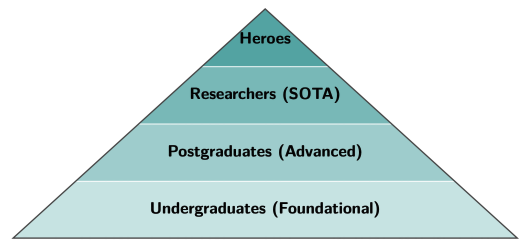
At the bottom of the pyramid sit people who have completed an undergraduate degree in a discipline, where they are all taught the fundamental knowledge of the discipline. Above that sit people who have done a postgraduate degree where they learned advanced topics. And above that sit researchers active in the discipline, who are all doing state-of-the-art work (SOTA) in one area or another. Sitting atop the pyramid are the heroes, the best researchers in the discipline who do, well, magical work.
People at every level in this pyramid know, or can know with a little bit of effort, all knowledge known to people at lower levels. A PhD student’s job is to find open research problems, usually something just beyond what is known at the Advanced level, and create new knowledge by solving those problems, whereupon they join the Researchers (SOTA) rank. (Creation of new knowledge is the criterion for the award of a PhD.) Most of these new results can, of course, be solved better and faster by the heroes of the discipline. But because there are usually only a small number of heroes and these heroes tend to focus on the hardest problems and mostly behave in socially responsible ways, new PhD students, suitably guided by more senior researchers, can almost always find good interesting open problems to solve and contribute meaningfully to the research community, until now.
We have just entered the age of AI, where it is becoming routine for frontier AI models to produce, at scale and at speed, new results that are previously in the exclusive domain of discipline heroes, and where it is easy for a novice with sufficient curiosity to self-taught the fundamental knowledge base of a discipline by interacting with inexpensive and widely available AI models without needing to go to a university. In that world, it is also now possible for someone with basic training in a discipline, obtained either through an undergraduate degree or professional on-the-job training, to understand all the advanced topics in the discipline with the help of AI. And, importantly from the perspective of PhD students, researchers in a discipline can now iterate quickly with commercial AI models to get to the next (incremental) state-of-the-art results at a faster and faster pace. This age of AI is shown in the following diagram.
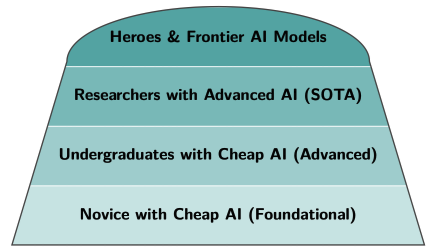
Compared to the age of heroes, every level of this pyramid has become much wider, and frontier AI models, which can be replicated easily at scale, sit at the top of the trapezoidal pyramid alongside human heroes. (I put frontier AI models ahead of regular researchers because the best output of these models – e.g. the nearly 18 million line proof of the Riemann Hypothesis in Lean – are really only understandable to the heroes at the moment.)
What value can a PhD student offer in this age of AI? A PhD student’s job remains the same: find open research problems and create new knowledge by solving them. But the job is a lot harder than before. Finding good open research problems becomes more important than ever when all the low-hanging fruits can be solved with a prompt to one’s favourite AI. The qualitative aspects of one’s solution to an open problem are also more important than ever in the presence of “proof abundance”, in that humanity need solutions that are understandable by and aesthetically appealing to humans, not more solutions that are only understandable by machines. Historically, only the best researchers in a discipline can do both those two things well. We are now basically asking each PhD student to operate at that level from close to day 1.
How should PhD students respond to that challenge. I can think of a number of ways. First of all, they can choose to work within the current system of knowledge creation, which usually means they have to try to
- produce new (incremental) results faster than other researchers, or
- produce higher quality results by, for example, untangling long incomprehensible AI-generated solutions to distill simpler arguments that can be more easily understood by other humans and then integrated into existing bodies of knowledge, or
- develop truly novel theories by bringing unique and contrarian insights tobear on long-standing open problems through multi- and inter-disciplinarywork, or
- work exclusively on the hardest open problems right at the edge of humanand AI capabilities, in the hope that this high-risk high-reward strategypays off for them.
Alternatively or in parallel, PhD students can choose to work on, rather than within, the system of knowledge creation. In practice, this means working on improving the AI models being used in the system, including producing better hardware, datasets, and algorithms (both learning and reasoning) to improve the speed, accuracy, reliability, and robustness of those AI models. Until the point where we reach Recursive Self Improvement (RSI), working on the knowledge creation system seems like a particularly attractive response because of its potential force-multiplying effect on all downstream activities.
Now, whatever they choose to do in the age of AI, PhD students should do so by keeping an eye on what will best position them for the upcoming age of Artificial General Intelligence (AGI) / Artificial Super Intelligence (ASI), which could just be a few years way. In that world, sketched in the following diagram
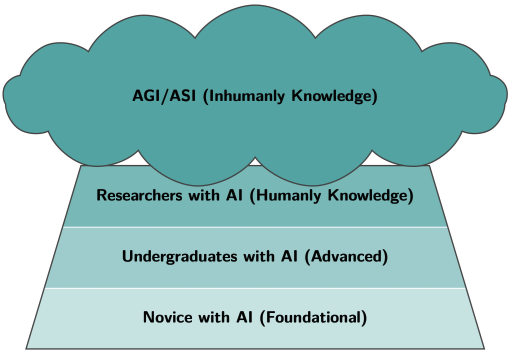
the AGI/ASImodels will possess and operate with knowledge that are mostly incomprehensible to our biological human mind – examples of such inhumanly knowledge are mathematical theorems with really long proofs that cannot be compressed down to human-digestible forms and the cloud laws that Noah Smith describes – and the best and most valuable thing a researcher can do is probably to continually probe the AGI/ASI mind and simultaneously expand human knowledge to make increasingly more slivers of AGI/ASI understandable to humanity. That’s a world that is incredibly scary and exciting at the same time. I can’t wait to see it!

